Ontorium’s Asset Layer and OXAU
Redefining the Standard of Real Assets with Efficiency.

5 min.
Where Trust Meets Utility
Tokenization alone does not fundamentally change how capital works. Recording an asset on a blockchain is a meaningful first step, but it does not make that asset more efficient, more productive, or more connected to the financial system. What institutions actually need is infrastructure where a tokenized asset, from the moment it is issued, is natively connected to financial protocols that allow it to generate yield, serve as collateral, and function as a real financial instrument. That is what the Ontorium Asset Layer was built to be. Not simply an issuance mechanism, but an integrated infrastructure where trust-based issuance and DeFi-native utility are designed together from the ground up. Building that kind of infrastructure requires getting the foundations right first.
Built for Institutional Standards
The Asset Layer is the foundation of the Ontorium Stack. In traditional markets, real assets are bound to fragmented processes of custody, settlement, and transfer. These systems preserve ownership and security, but they are not designed for composability or participation in programmable financial infrastructure. As a result, the financial utility of real assets remains limited relative to their economic significance.
The Asset Layer addresses this directly. It defines how real assets are represented, verified, and made usable onchain, establishing the base asset logic of the entire stack including legal structure, asset ownership, backing design, reserve integrity, and redemption. That logic is enforced through four concrete mechanisms.
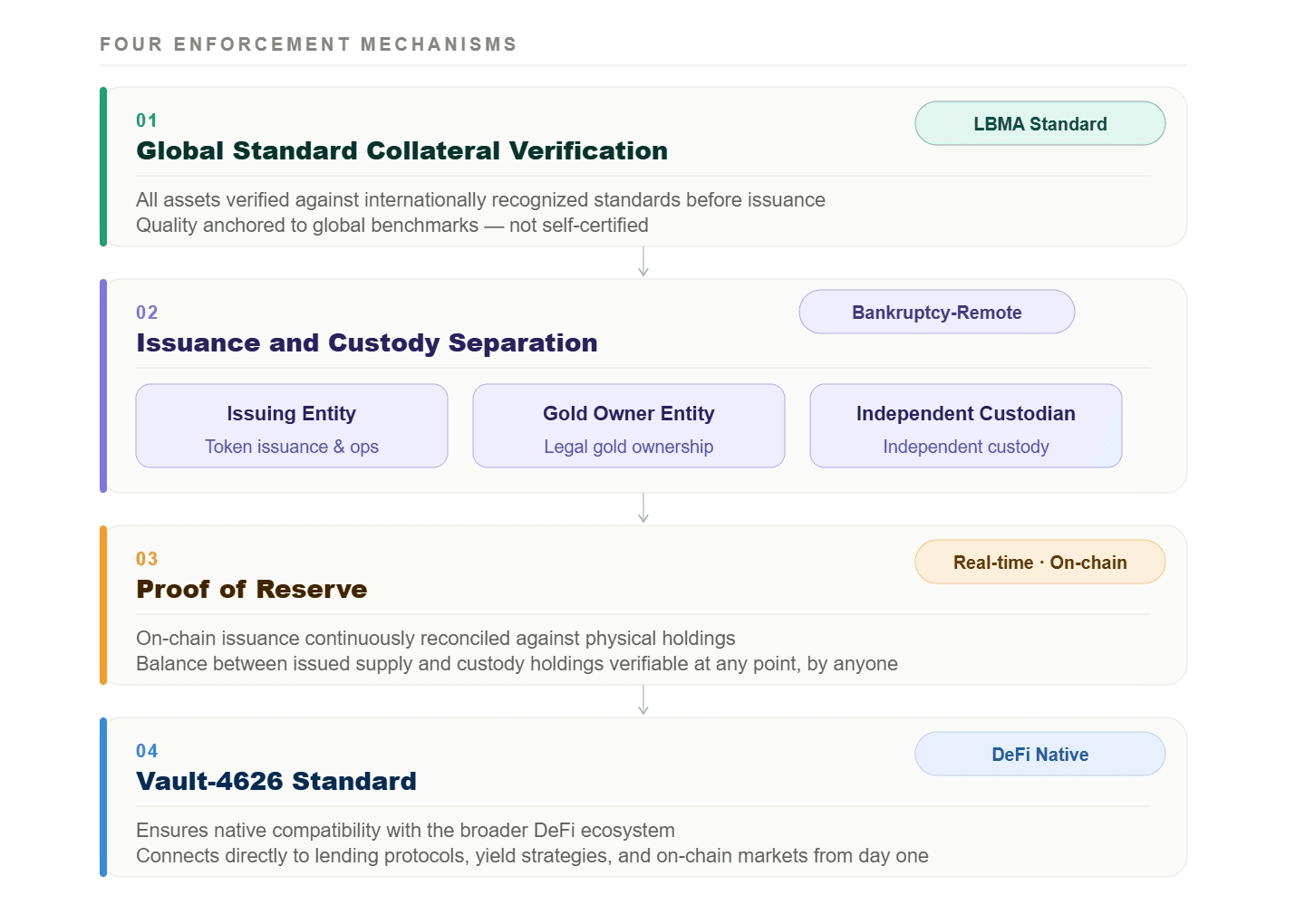
Global Standard Collateral Verification
All assets are verified against internationally recognized collateral standards before issuance. As an example, Ontorium's first flagship asset, OXAU, follows the London Bullion Market Association (LBMA) standard
Quality is anchored to global benchmarks, not self-certified
Issuance and Custody Separation
Issuing Entity handles token issuance and platform operations
Gold Owner Entity holds legal ownership of underlying physical gold within a purpose trust administered by an independent trustee
Physical asset custody is handled through a verified independent custody institution
Reserve ownership and issuance operations are intentionally kept distinct, supporting a bankruptcy-remote framework
Proof of Reserve
Onchain issuance is continuously reconciled against physical holdings
The balance between issued supply and custody holdings is verifiable at any point, by anyone
ERC-4626 Vault Standard
Ensures native compatibility with the broader DeFi ecosystem
Issued assets connect directly to lending protocols, yield strategies, and onchain markets from day one
Anchoring Hancom Gold Exchange's Expertise
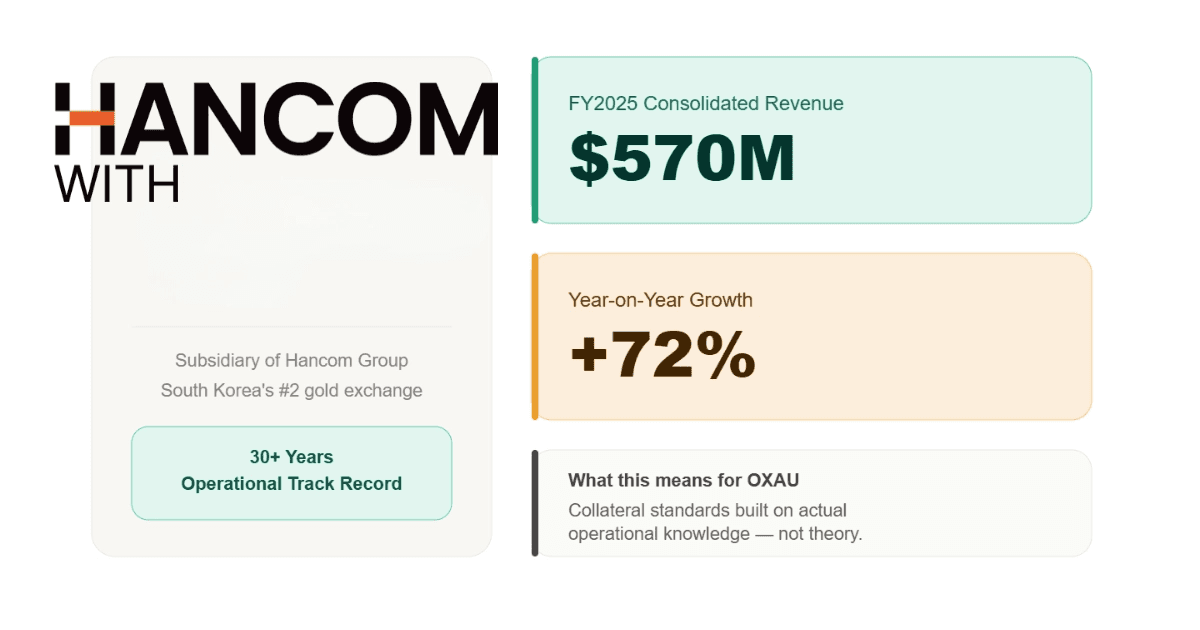
The structural framework above does not exist in isolation. It is backed by an organization with the operational depth to make it credible at every level. Ontorium's first asset is gold. That decision was not driven by market trends. It was driven by an operational foundation that already exists. Hancom Gold Exchange, a subsidiary of Hancom Group, is South Korea's second largest gold exchange. In 2025, it recorded consolidated revenue of KRW 771.2 billion ($570M), representing 72% year-on-year growth. That is not a projection. It is a verified track record of physical gold acquisition, custody, and distribution at institutional scale. The expertise built through years of operating in physical gold markets is directly embedded in the design of OXAU. The collateral standards, the custody protocols, the redemption infrastructure, each reflects operational knowledge that comes from actually running a gold business, not from theorizing about one. An organization that understands gold at that level is a fundamentally different issuer than a private project standing up a token. That difference is what OXAU is built on.
OXAU: From Issuance to Utility
OXAU is the flagship asset of the Ontorium Asset Layer. Fully backed by allocated physical gold and designed for utility across the entire Ontorium Stack, one token represents one gram of LBMA-certified 99.99% pure gold, held in segregated custody. The purpose is not merely to digitize gold ownership. It is to make gold work.
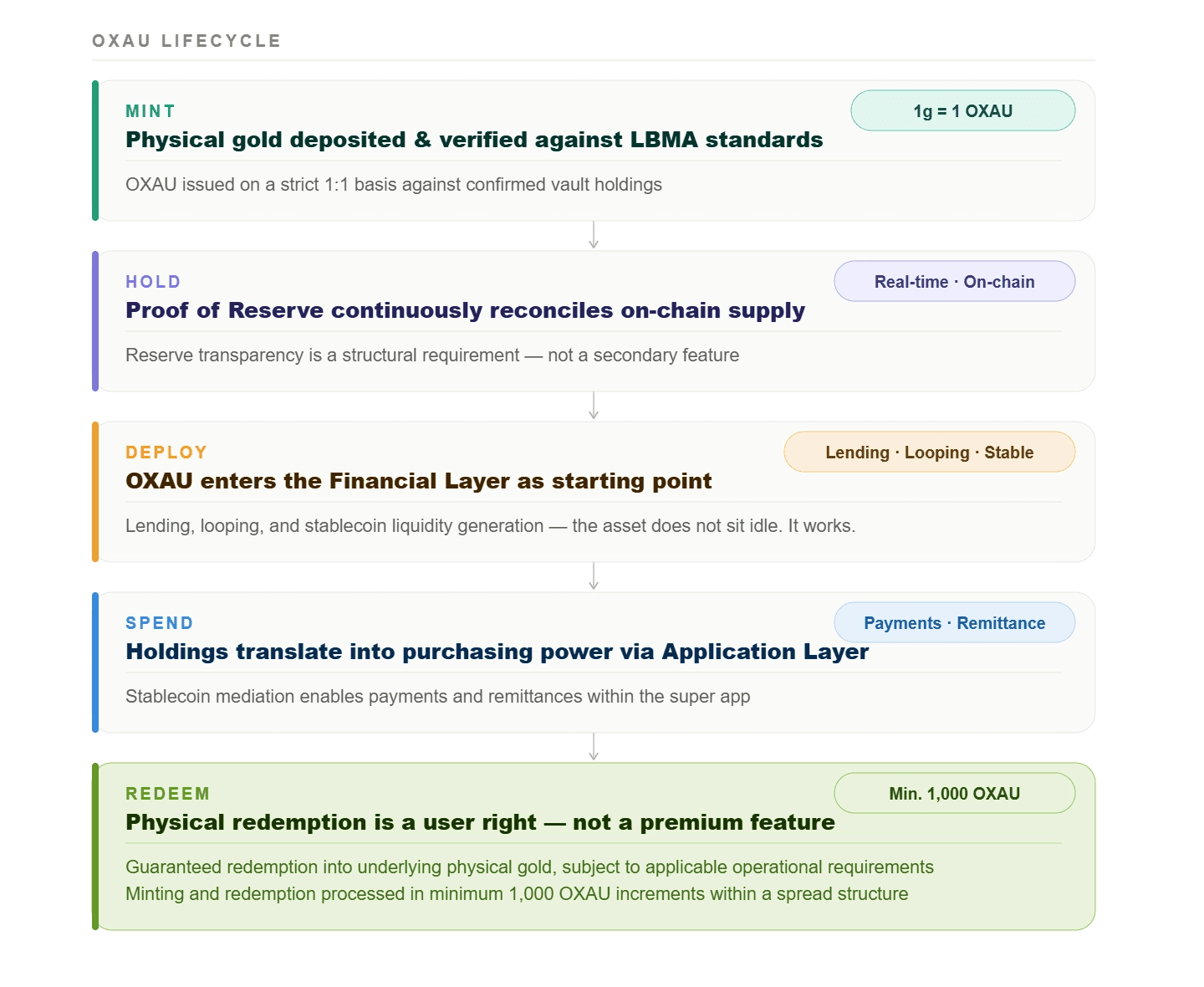
Mint
Physical gold is deposited and verified against LBMA certification standards
OXAU is issued on a strict one-to-one basis against confirmed vault holdings
Hold
Proof of Reserve continuously reconciles onchain supply against physical holdings
Reserve transparency is a structural requirement of the Asset Layer, not a secondary feature
Deploy
OXAU enters the Financial Layer as the starting point for lending, looping, and stablecoin liquidity generation
The asset does not sit idle. It works.
Spend
OXAU holdings translate into purchasing power within the Application Layer super app through stablecoin mediation
Available for payments and remittances
Redeem
Physical redemption is a user right, not a premium feature. OXAU guarantees redemption into underlying physical gold subject to applicable operational requirements, with minting and redemption operating within a spread structure relative to the reference price.
For operational clarity, minting and redemption are processed in a minimum of 1,000 OXAU increments
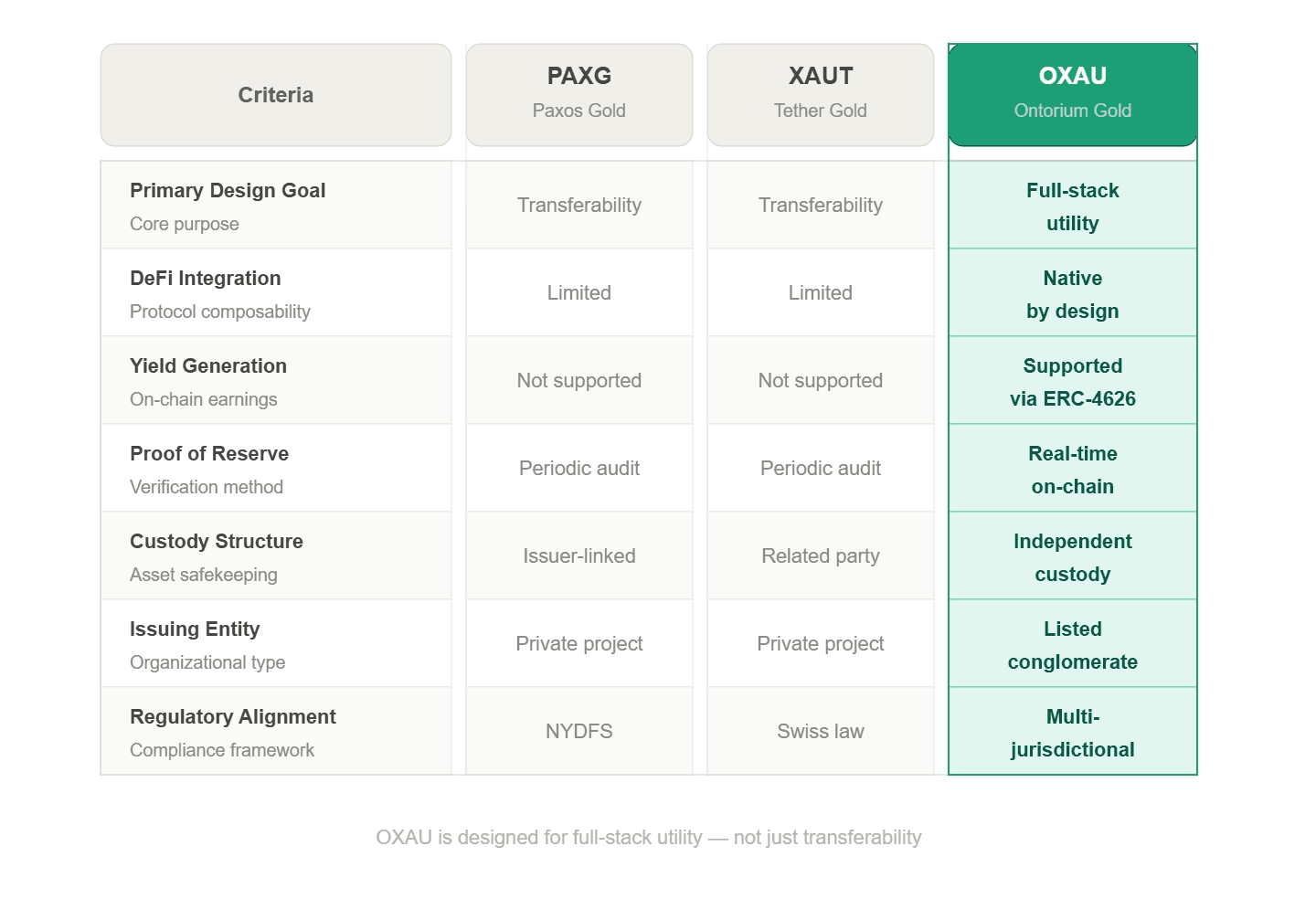
OXAU vs. Existing Gold Tokens
Beyond Gold: Scaling the Trust Architecture
The comparison above reflects where the market stands today. What it does not capture is where the Ontorium Asset Layer is going. OXAU is where the Ontorium Asset Layer begins. It is not where it ends. The Asset Layer is designed to support programmability and expansion from the outset. While OXAU is the flagship implementation today, the Asset Layer is built to accommodate additional real assets over time. New assets can be introduced into the same structural framework so long as they satisfy the requirements of ownership clarity, backing integrity, reserve transparency, redemption logic, and onchain usability. Real estate, private credit, commodities, and beyond. In this sense, the Asset Layer is both the trust layer and the expansion layer of the Ontorium Stack. If RWA 1.0 put gold on a blockchain, RWA 2.0 puts gold to work. OXAU is where that starts.