Ontorium's Financial Layer
From Storage to Strategy.

5 min.
Activating the Financial Engine Within Real Assets
Once an asset enters the Financial Layer, it stops being a static store of value and becomes a strategic financial instrument. The Financial Layer is responsible for transforming base assets into productive financial primitives. Where the Asset Layer establishes trust, backing, and representation, the Financial Layer activates those assets within onchain markets, unlocking liquidity, enabling collateral utility, and creating capital-efficient financial use cases for real assets.
That is what the Financial Layer was designed to enable. It does so through three distinct strategies, each serving a different financial objective, and each executable without liquidating the underlying position.
Why the Financial Layer Exists
Ownership alone is not enough. A real asset represented onchain becomes significantly more useful when it can support borrowing, lending, liquidity access, and yield-generating financial activity.
The Financial Layer serves three core functions within the Ontorium Stack.
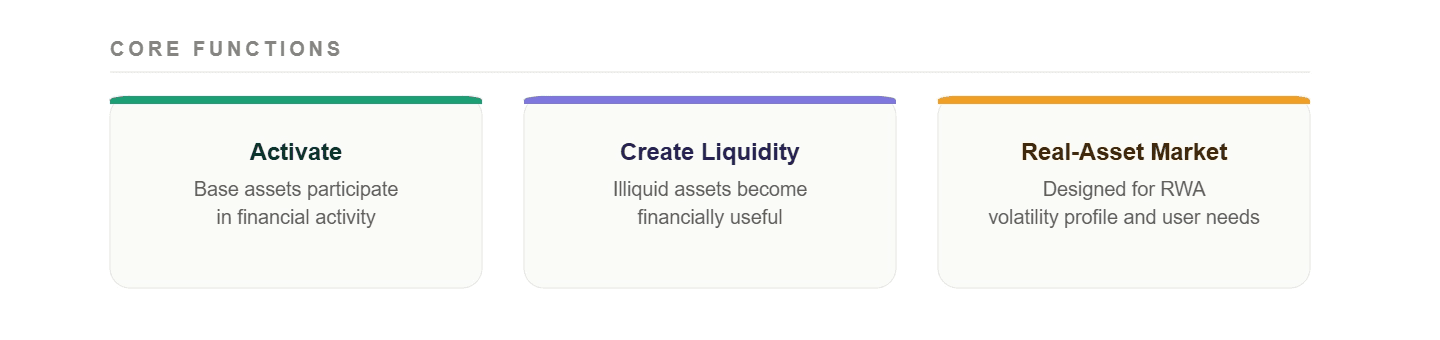
Activating Base Assets: Allows assets to participate in financial activity rather than remain static holdings. Assets can be supplied, used as collateral, borrowed against, or integrated into capital-efficient strategies
Creating Liquidity Access: Many real assets are valuable but operationally illiquid. The Financial Layer allows these assets to become financially useful without requiring outright disposal of the underlying exposure
Real-Asset Market Structure: Real assets differ from crypto-native assets in volatility, liquidity profile, reserve basis, and user expectations. AQUA is built to reflect these characteristics, with collateral parameters, borrowing conditions, and liquidation logic calibrated specifically for real asset backed environments rather than applied from a crypto-native template
AQUA: The Financial Layer in Action
The flagship implementation of the Financial Layer is AQUA, a capital-efficient lending market designed specifically for real world asset collateral such as OXAU.
AQUA is not positioned as a general-purpose lending market. Its design logic is centered on the requirements of real asset finance, how collateral should be evaluated, how liquidity should be managed, and how risk controls should be tailored to a market built around trusted base assets rather than crypto-native volatility alone.
Through AQUA, OXAU and future real asset primitives can be activated within lending markets rather than held solely as static stores of value.
Three Core Strategies
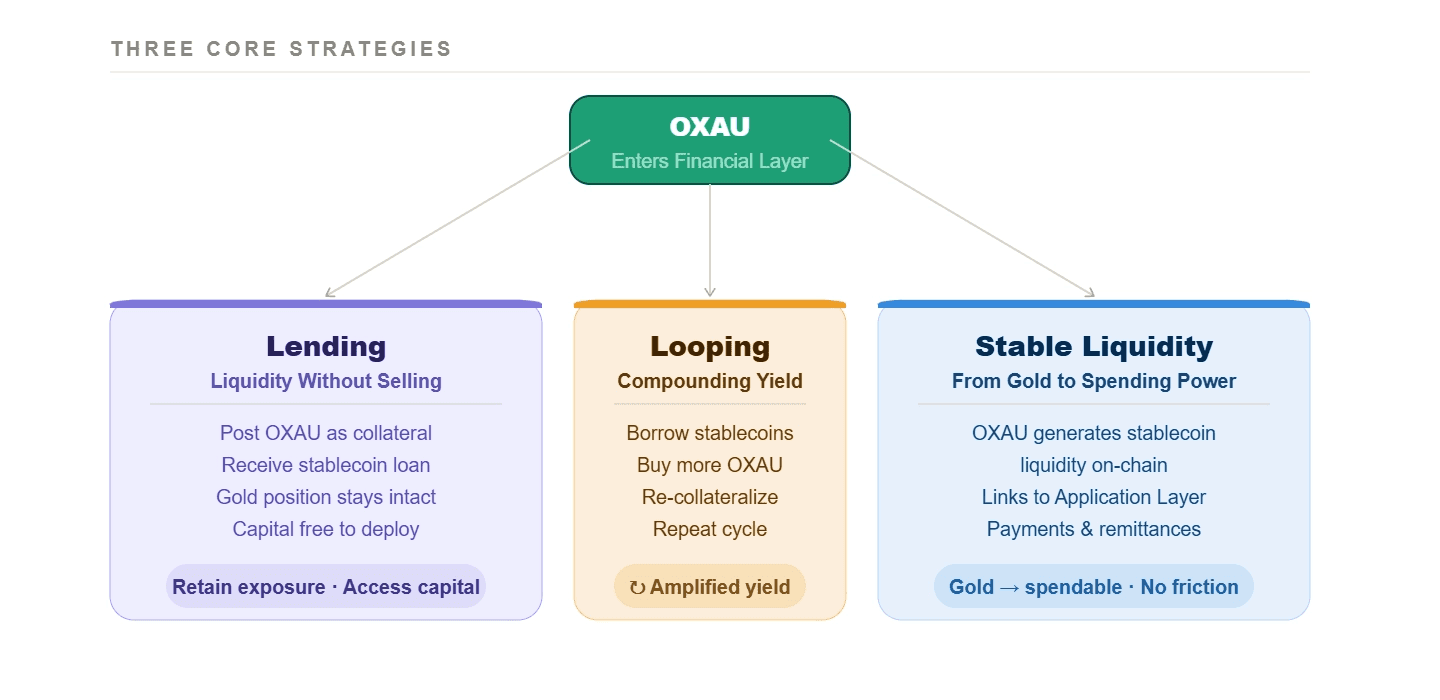
Lending: Liquidity Without Selling
In traditional settings, holders of hard assets face a limited choice: retain the asset without liquidity, or sell it to access capital. AQUA introduces a third path.
OXAU posted as collateral to access stablecoin liquidity onchain
Gold position remains intact throughout the borrowing period
Capital unlocked for deployment, reinvestment, or operational use
Asset holders can retain exposure to the underlying asset while accessing liquidity. Real assets serve as the basis for borrowing and market activity, increasing their utility beyond passive storage.
Looping: Compounding Exposure and Yield
For those seeking to maximize their position, the Financial Layer supports looping strategies that allow holders to compound their exposure through repeated cycles of borrowing and reinvestment.
Borrowed stablecoins used to acquire additional OXAU
New OXAU posted as collateral for further borrowing
Process repeated to build higher gold exposure relative to initial capital
Yield and exposure adjusted based on collateral ratio at each stage
Stablecoin Liquidity: From Gold to Spending Power
The third strategy bridges the Financial Layer and the Application Layer. OXAU positions can be converted into stablecoin liquidity that connects directly to real world purchasing and payment capability.
OXAU position used as the basis for stablecoin liquidity generation
Liquidity connects directly to the Application Layer super app
Available for payments, remittances, and everyday financial activity
This is where onchain gold becomes genuinely spendable, without the friction of selling, converting, and transferring through legacy channels.
Risk Architecture
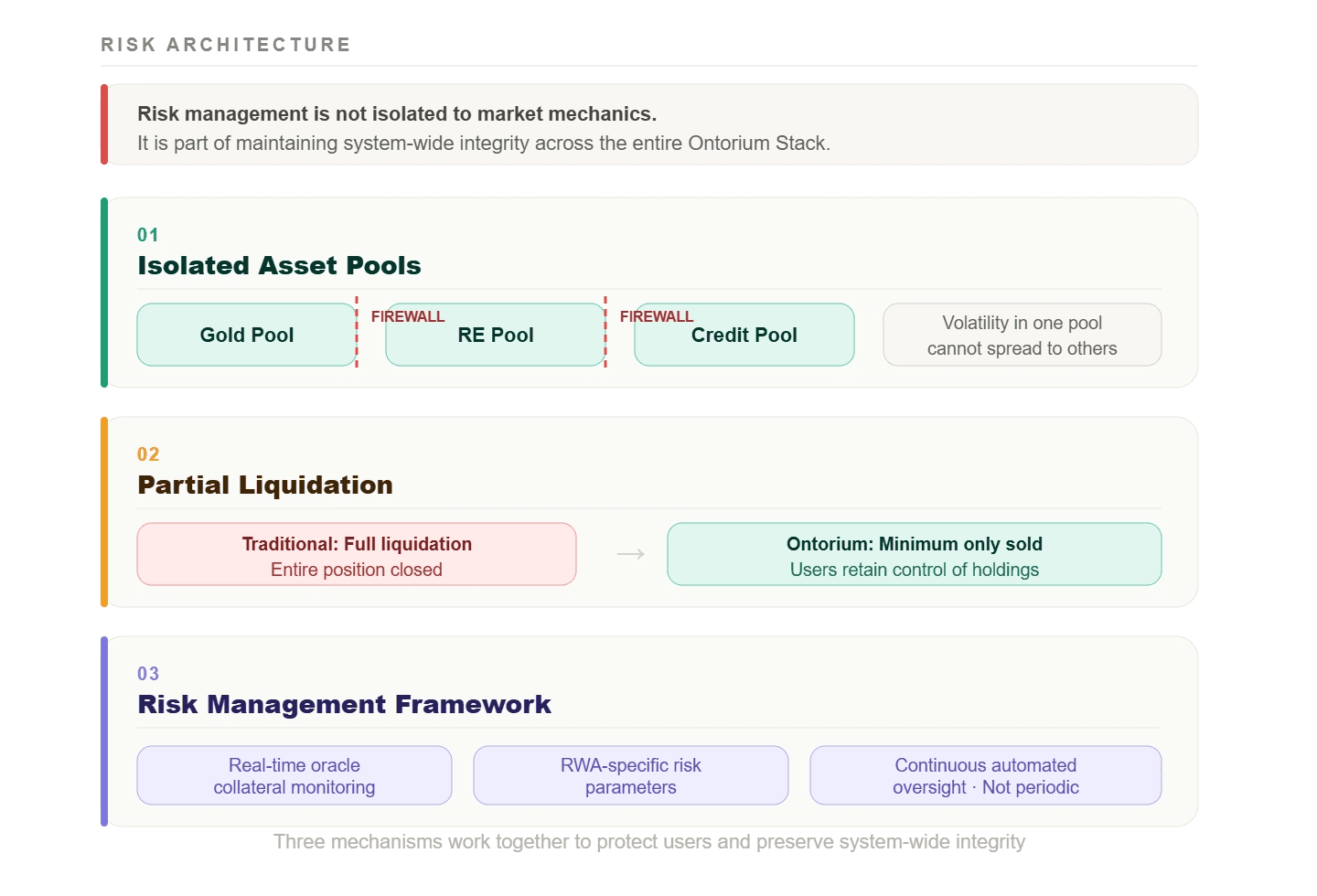
The Financial Layer is designed not only for capital efficiency, but for structural resilience. In a full-stack architecture, weaknesses in the Financial Layer can undermine the usability of the Asset Layer and the credibility of the Application Layer. Risk management is therefore not isolated to market mechanics. It is part of maintaining system-wide integrity.
Three mechanisms work together to protect users and preserve that integrity under all market conditions.
Isolated Asset Pools
Each asset pair operates within its own independent liquidity pool
Volatility or stress in one pool cannot propagate across the broader ecosystem
System integrity is preserved at the structural level, not managed reactively
Partial Liquidation
When collateral ratios fall below required thresholds, only the minimum necessary position is liquidated
Full position liquidation is avoided wherever structurally possible
Users retain meaningful control over their holdings even during periods of market stress
Risk Management Framework
Collateral values are monitored in real time through onchain oracles
Protocol-level controls reflect the distinct risk profile of real asset collateral, including volatility characteristics, liquidity behavior, and reserve basis
Risk parameters are set based on an understanding of real asset market structure and characteristics, rather than assuming crypto-native behavior
System health is maintained through continuous, automated oversight rather than periodic review
Financial Layer for Every Asset, Not Just Gold
OXAU is the first asset to move through the Financial Layer. It will not be the last.
Every asset onboarded to the Ontorium Stack inherits the same financial infrastructure. The lending protocols, looping strategies, stablecoin liquidity mechanisms, and risk management framework apply equally to real estate, private credit, commodities, and any other asset class that enters through the Asset Layer.
The Financial Layer does not need to be rebuilt for each new asset. It is designed to scale. As the Ontorium Stack grows, the Financial Layer grows with it, deepening the financial ecosystem available to every asset, every institution, and every user that participates in it.